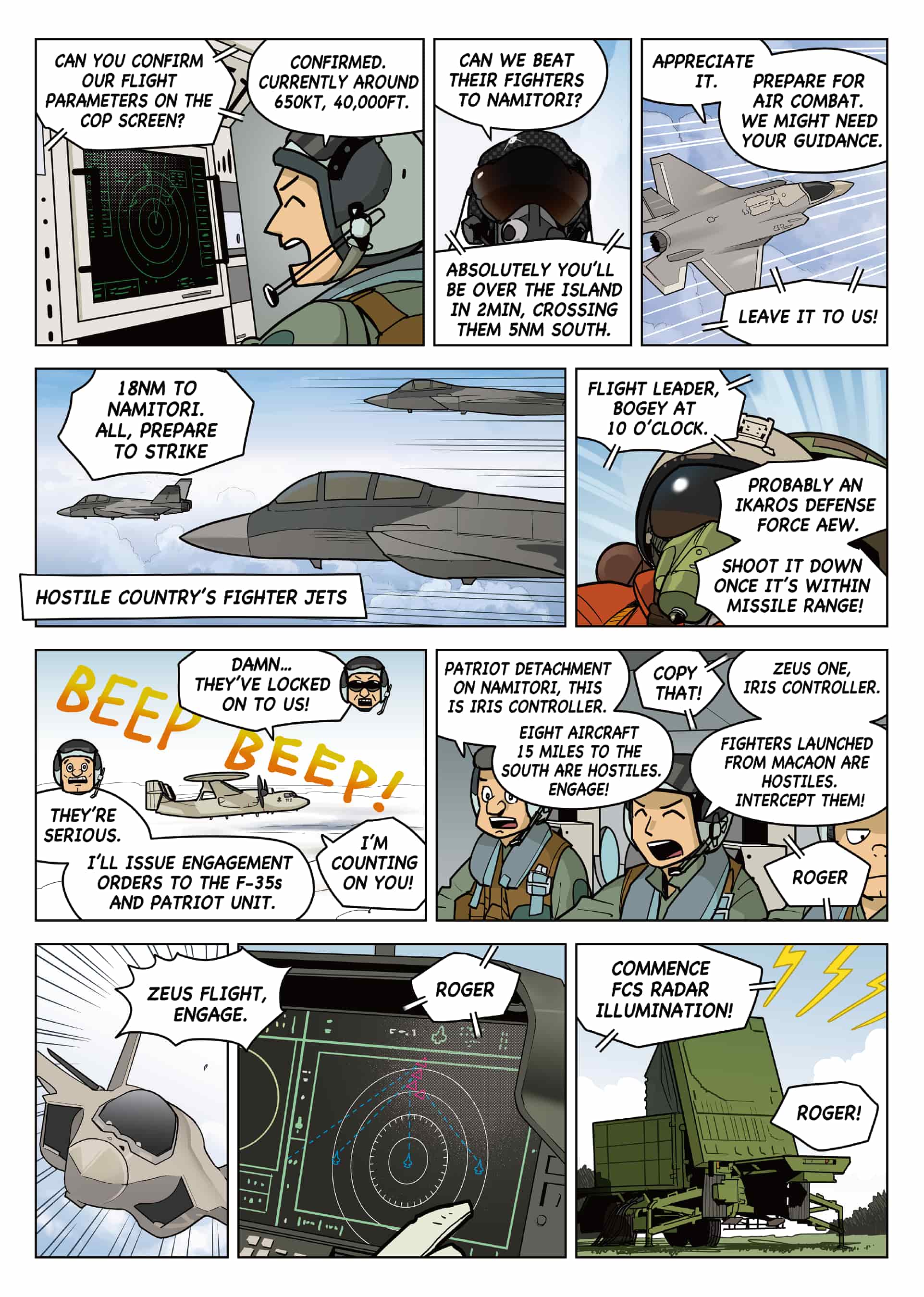
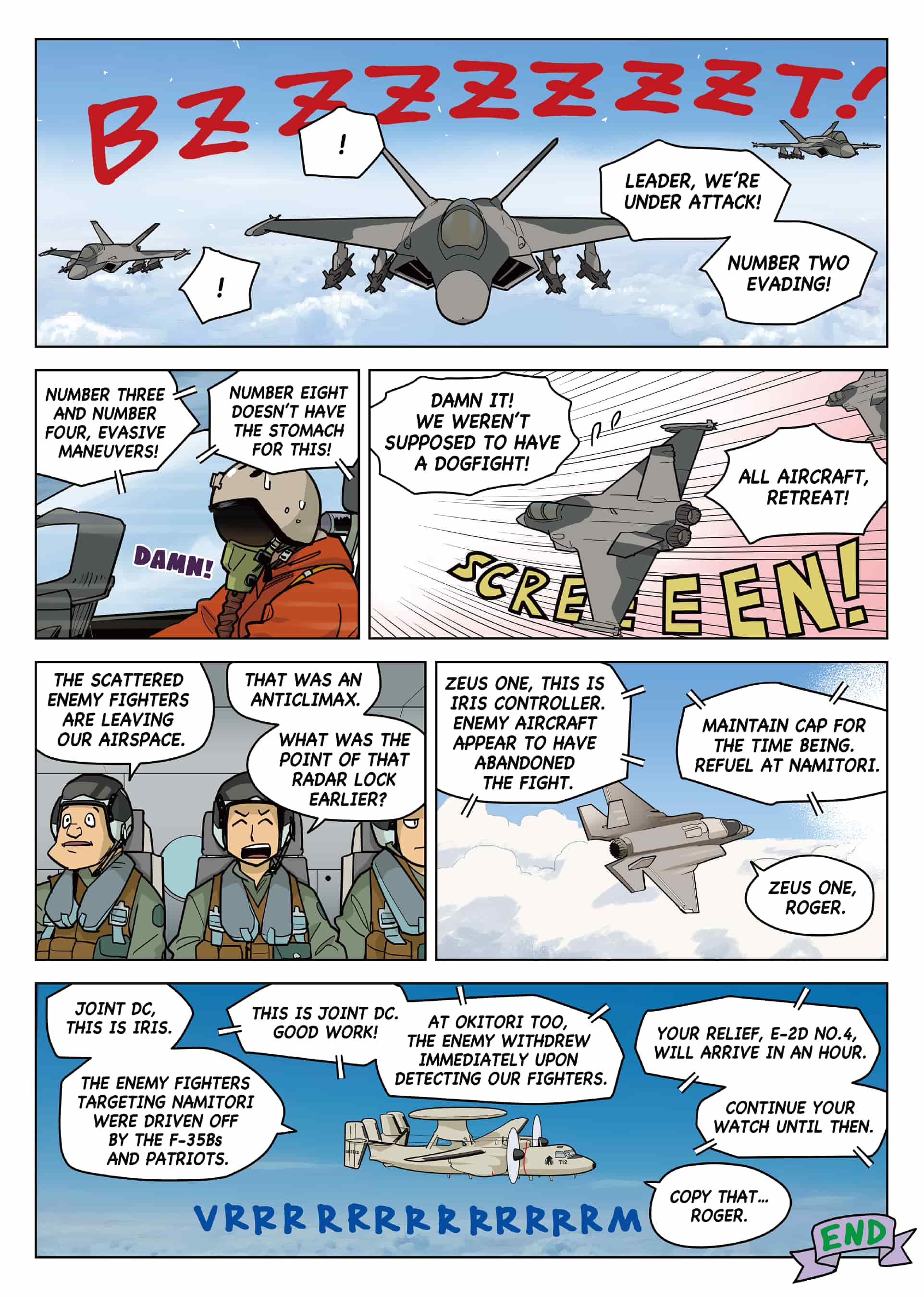
◎This article is a collaborative project with the monthly magazine "J Wing. ◎This is a work of fiction. Any resemblance to actual persons, living or dead, organizations, or events is purely coincidental.
Commentary Article:The E-2D and Its Hidden Command and Control Capabilities
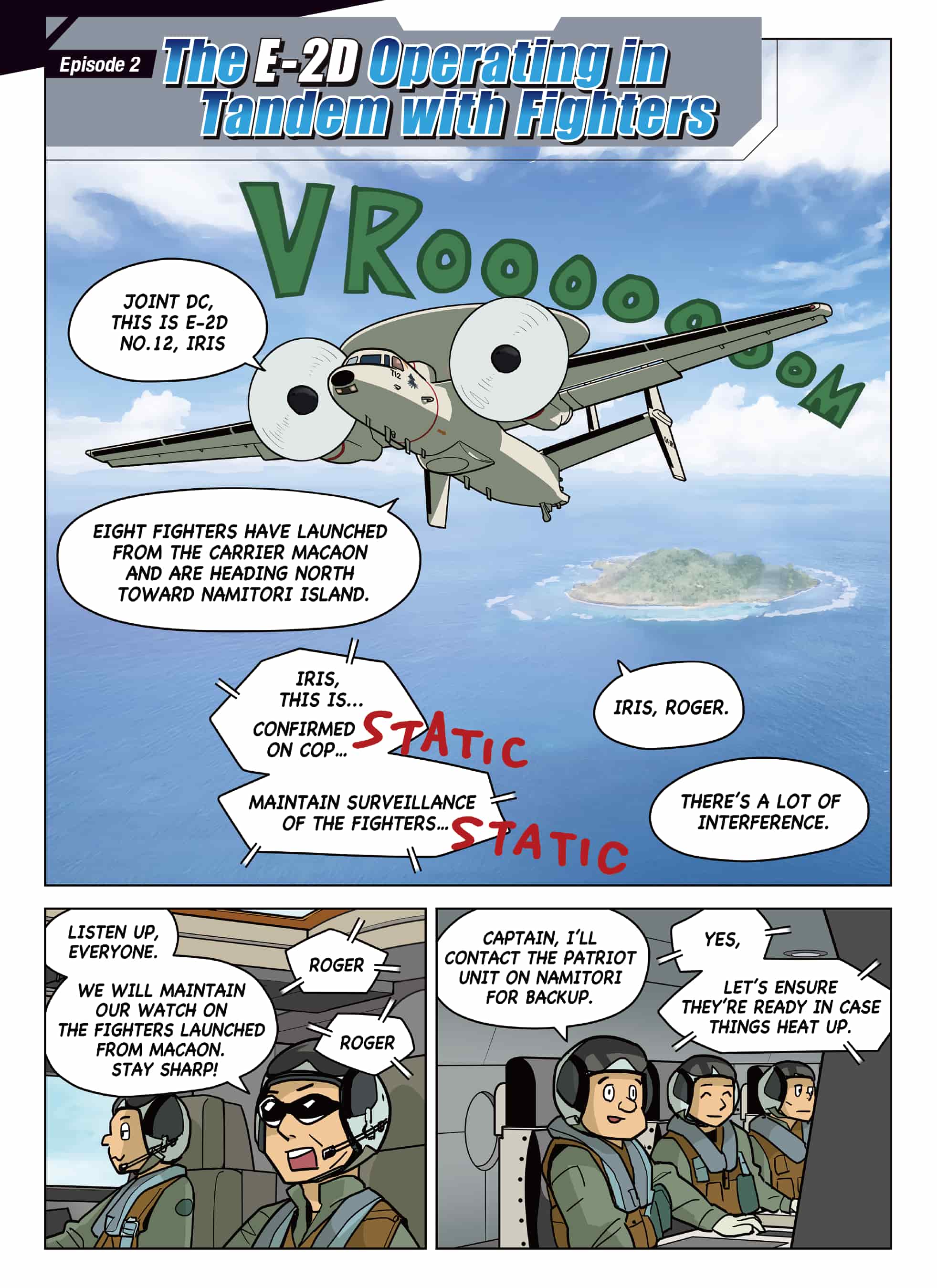
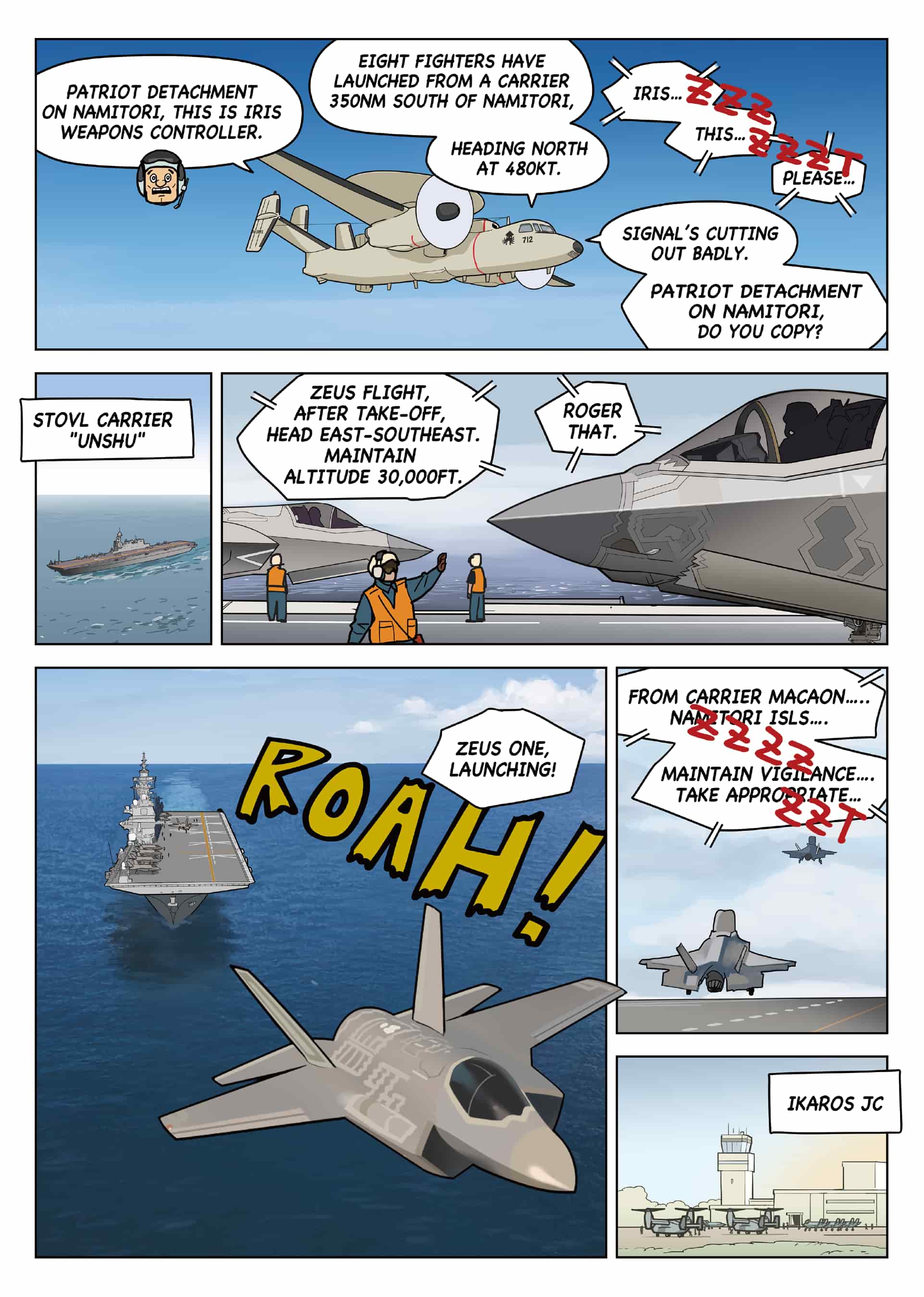
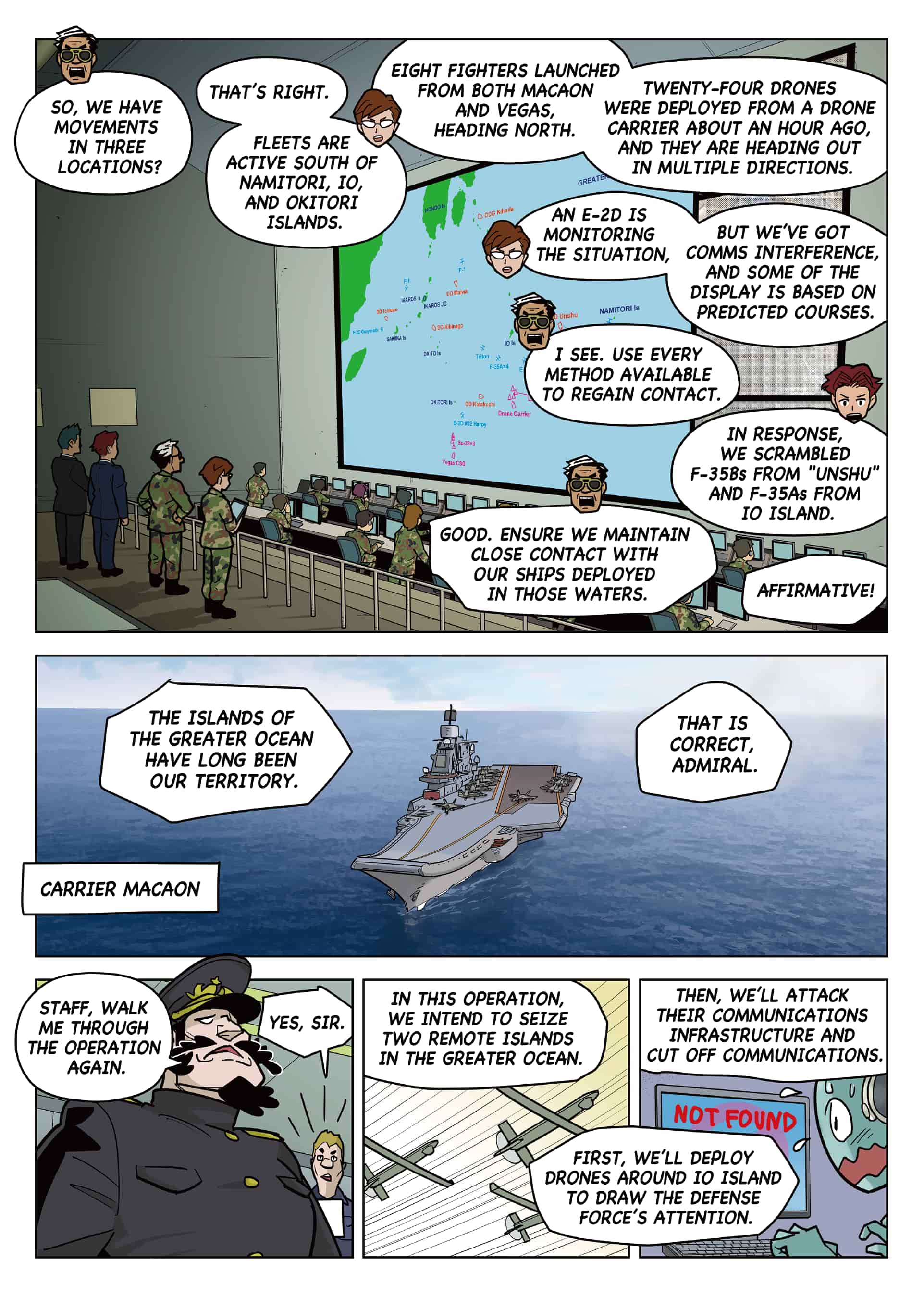
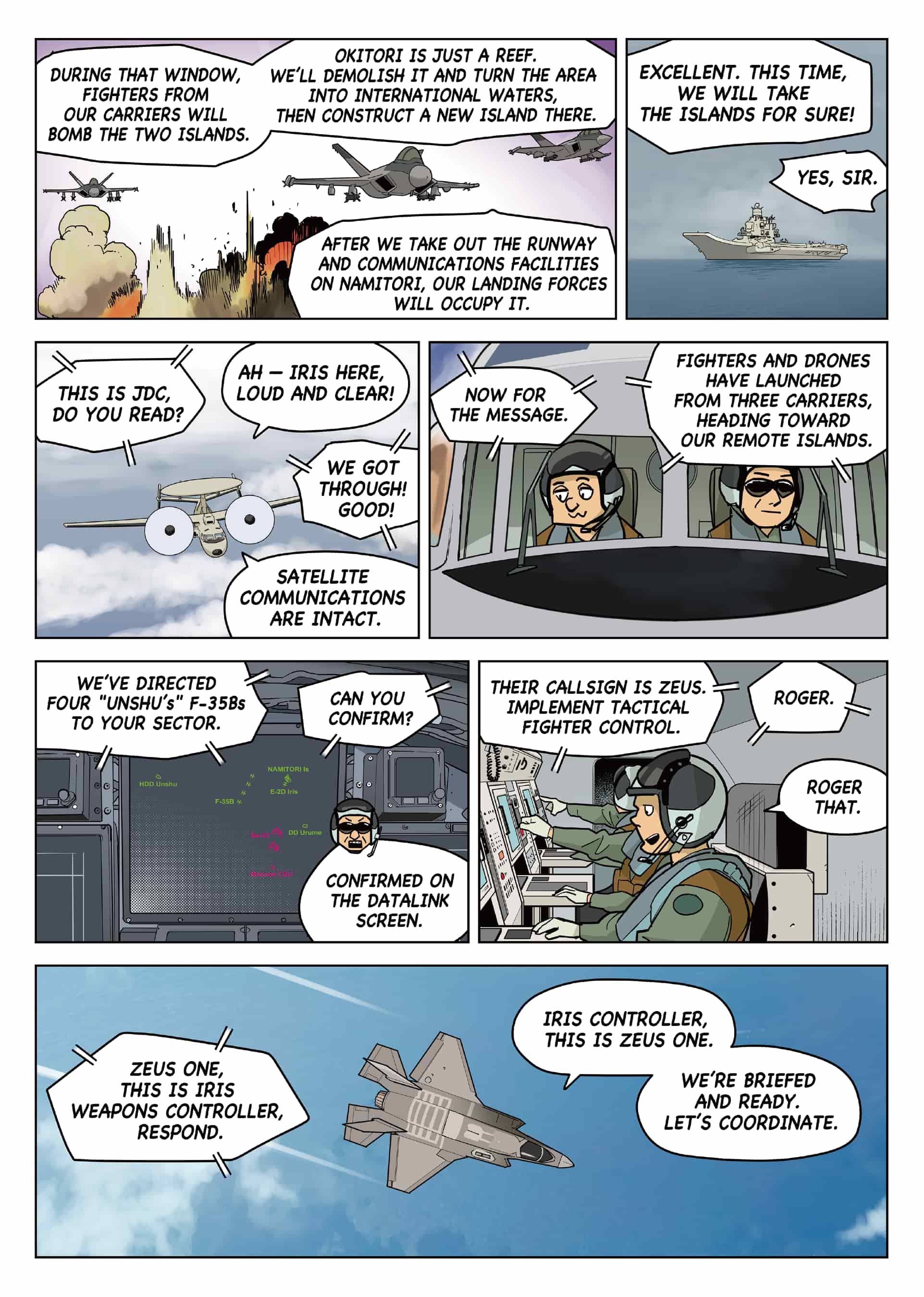
In the manga, an E-2D controllers command and control the F-35Bs and Patriot SAM units, successfully driving away the hostile fighter jets attacking the island. However, while the aircraft is “AEW & C” (Airborne Warning and Control), the Air Self-Defense Force only uses the E-2D's “AEW” (Airborne Early Warning) capabilities. Will the “C” (Control) continue to be unused? ──Koji INOUE
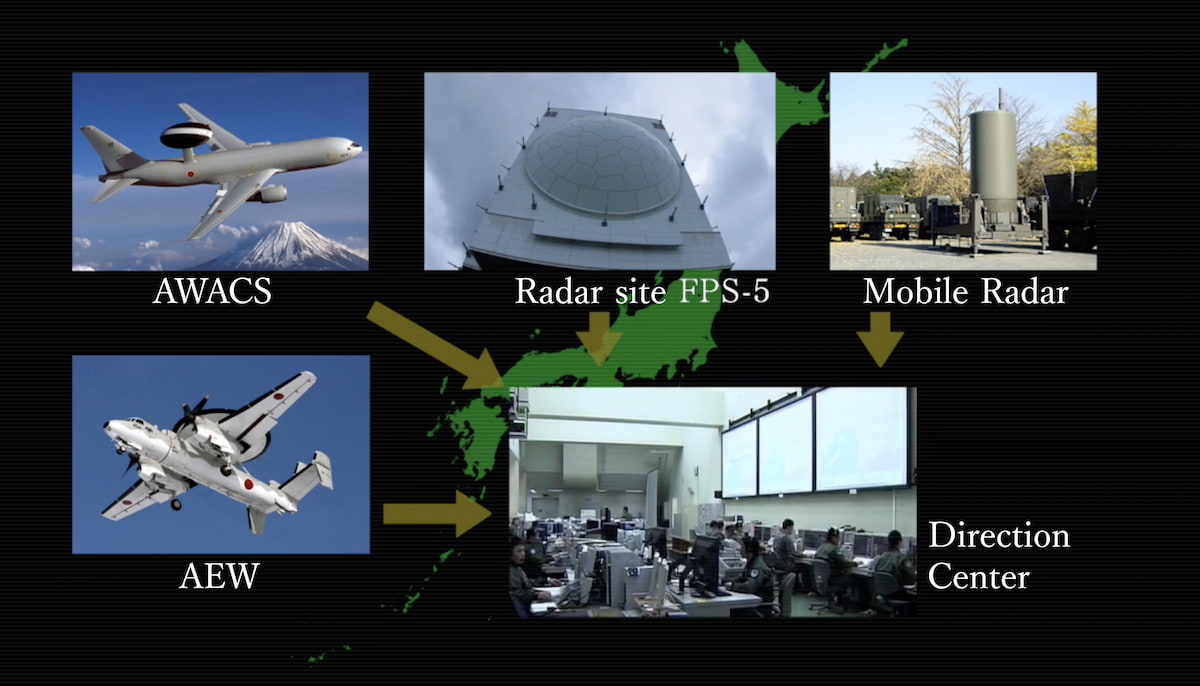
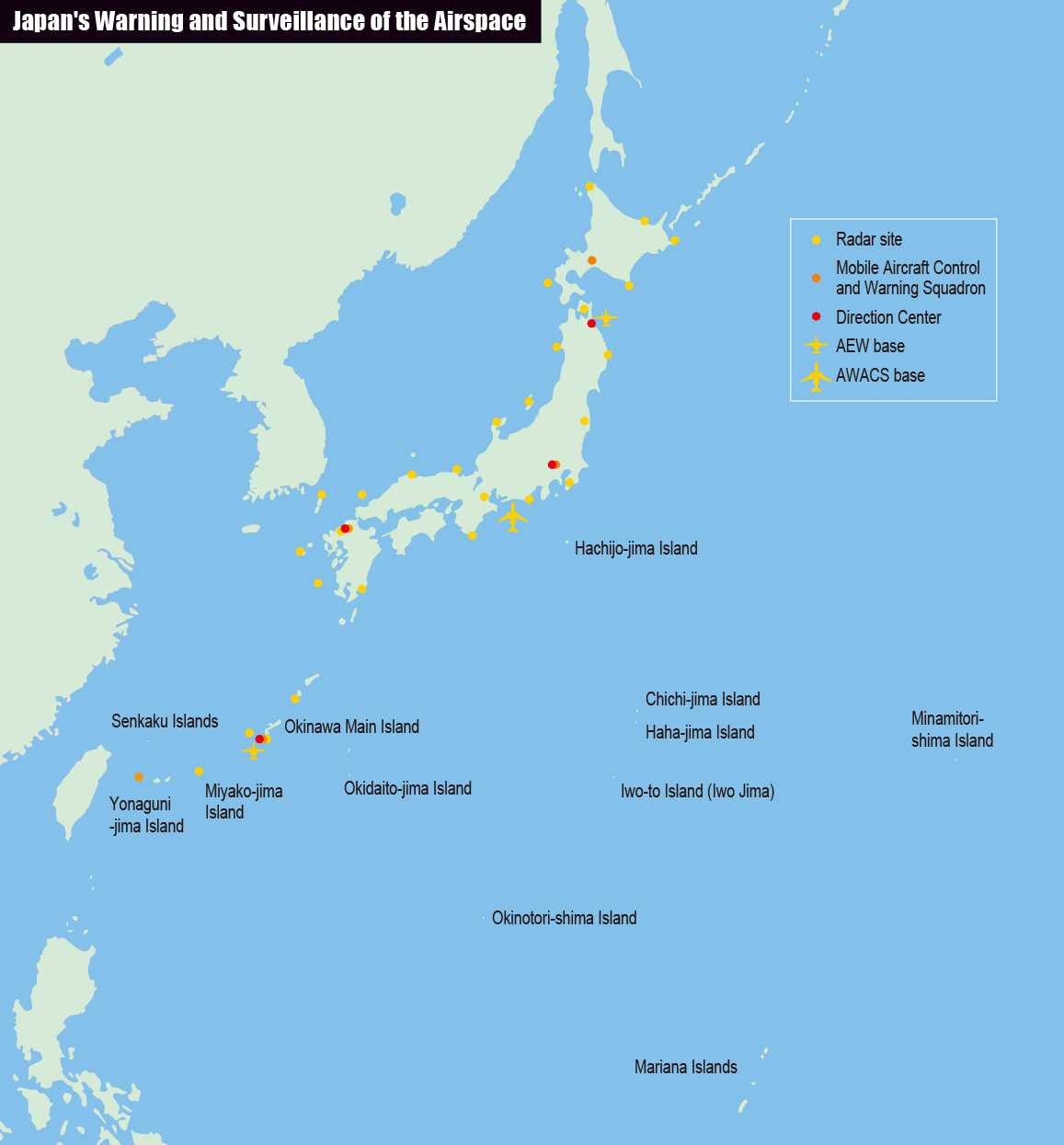
This photo illustrates the ASDF’s air defense surveillance and control operations. Information on the surrounding airspace obtained by surveillance radars and mobile warning radars around the country, as well as E-2C/E-2D AEW and E-767 AWACS in the sky, is collected at four Direction Centers across the country. Source: Air Self-Defense Force public relations video Significance of Having Command and Control Capabilities “Dispatched” to the Ocean
Japan has long been building up its defense capabilities and posture under the principle of “not creating a power vacuum.” Since it have no intention of launching an offensive abroad, the primary focus in the skies has been on countermeasures against airspace violations.
When it comes to countering airspace violations in and around the Japanese mainland, missions can often be accomplished through ground-based radar networks and instructions from weapons controllers at the Direction Centers established in each region. The role of AEW such as the E-2 is to cover the “gaps” in ground-based radars by installing their radars in the air.
However, recent changes in the security environment have forced us to seriously reconsider how we can defend Japan's skies in actual combat. Moreover, this does not only apply to the skies over the Japanese archipelago and the Southwest Islands, but also extends to the skies over the Pacific Ocean. This raises the question of command and control capabilities in air combat. Why?
The Pacific Ocean is an area that cannot be covered by ground-based radar networks alone. What happens if we expand the geographical areas to that extent? In theory, one option would be to fly AEW over the Pacific Ocean, send the detection information via data link to the Japan Aerospace Defense Ground Environment (JADGE)* system, and have it viewed and informed by weapons controllers at the Direction Centers on the mainland. However, can we always rely on the data link systems? Furthermore, from the weapons controller's perspective, fighter jets flying over the Pacific Ocean are outside their line of sight, so they cannot communicate with the UHF radios normally used for air control.
In that case, it would be necessary not only to see the overall picture from the ground and control interception, but also to have local control capabilities on the spot, wouldn’t it?
*JADGE is a Japan-developed, nationwide air defense system that automatically conducts command and control of friendly aircraft and processes and disseminates track data for responding to airspace incursions.
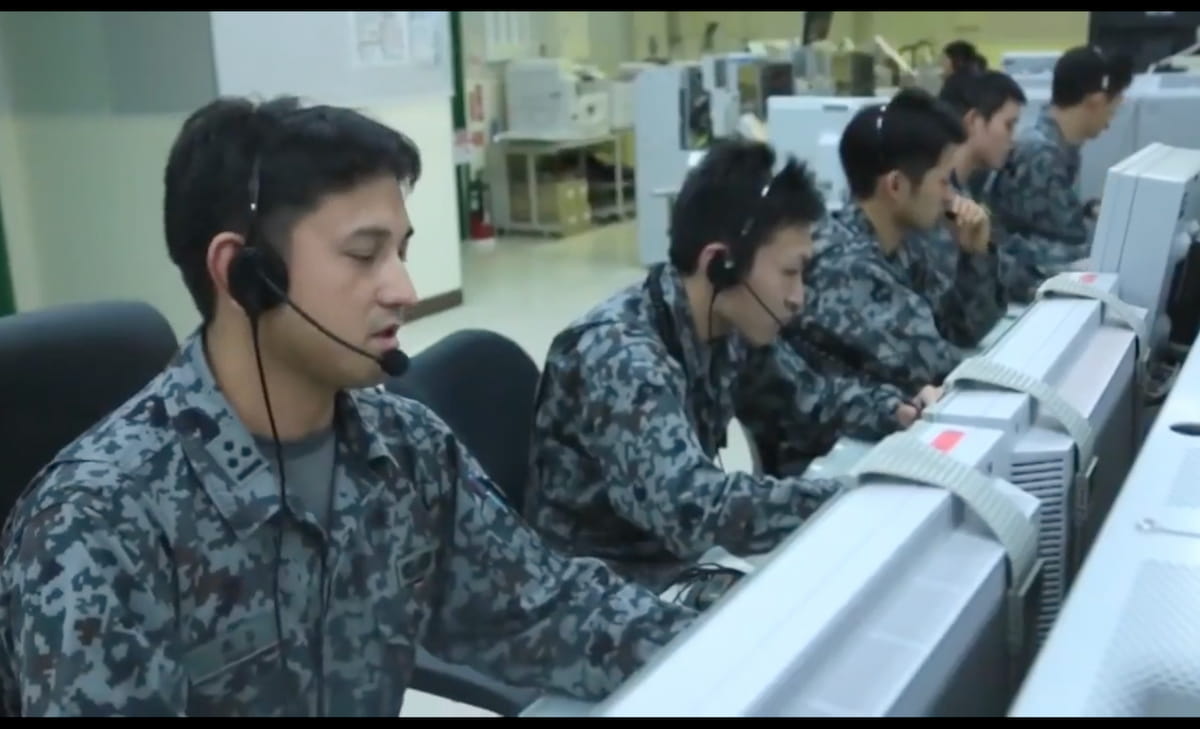
Weapons controllers at the centers direct fighter jets tasked with airspace violation countermeasures. Source: Air Self-Defense Force public relations video Improved Situational Awareness Capabilities Puts Increased Burdens on Pilots
In recent years, fighter jets have been equipped with data links and have improved onboard computers, greatly improving their situational awareness. However, as a result, the amount of information flowing into fighter pilots has increased. It may sound easy to say that pilots must plan their operations while looking at that information, but the burden on them is becoming too great to ignore.
In the future, it may be possible to use artificial intelligence (AI) to automatically identify high-threat targets from among those detected by radar and issue a warning, but current systems have not yet reached that level.
Moreover, the number of friendly and enemy aircraft engaging in a real combat will likely increase, compared to training, making operation planning and targeting a big challenge. Rather than leaving it entirely to the fighter pilots, they will need support from controllers who can oversee the overall situation.
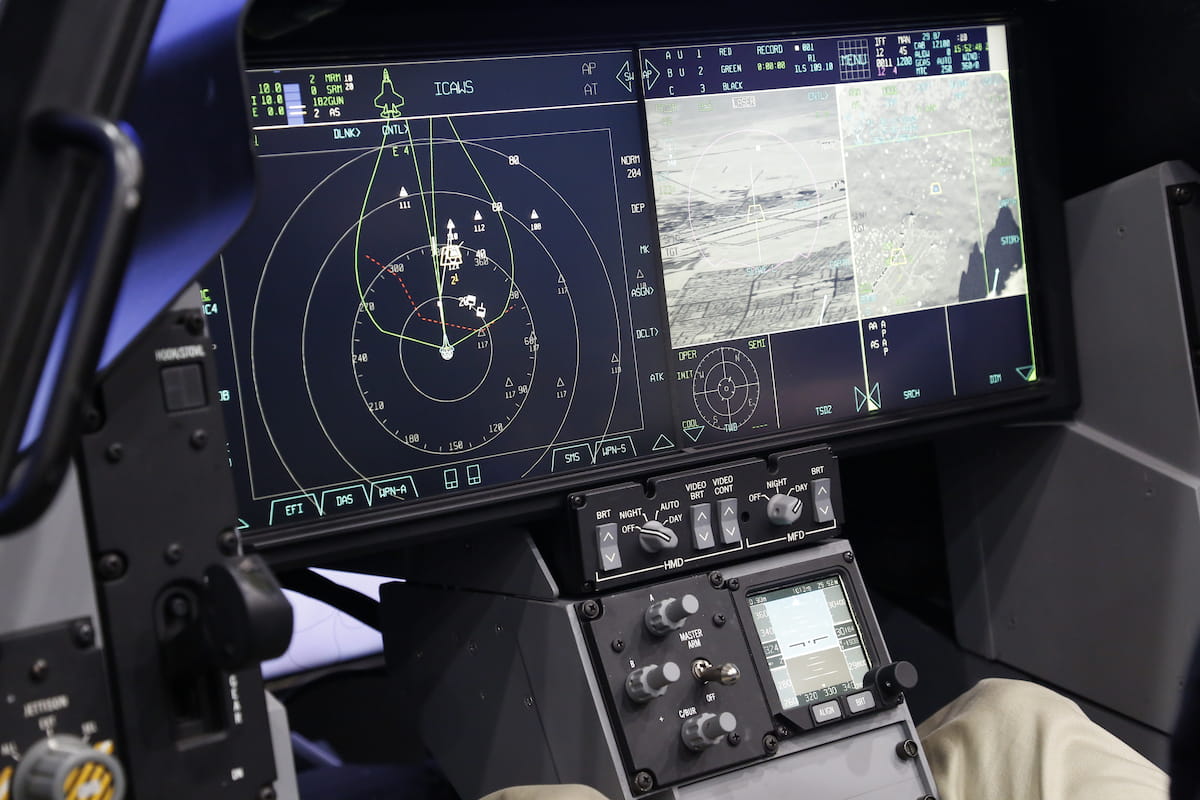
The cockpit display of an F-35 fighter jet displays the battle situation aggregated via data link. The formation leader is now expected to take on the role of mission commander. Photo: Koji INOUE Unlocking the Full Potential: The E-2D as an Enhanced Evolution of the E-2C
The E-2D is originally equipped with AEW&C (Airborne Early Warning and Control) capabilities, meaning it can provide not only airborne early warning (AEW) but also control (&C). This means that the same functions performed by weapons controllers at Direction Centers can also be carried out from the aircraft. The same level of images that JADGE displays on the screen in the Direction Center can be displayed on the aircraft.
The US Navy's E-2D crew is five people, just like the previous model, with a pilot and co-pilot, plus three Combat Information Center (CIC) officers stationed in the rear. These three officers are responsible for control duties, and with the E-2D, the co-pilot can also assist in control duties if necessary.
The E-2D’s radar resolution has improved compared to the E-2C, and it has enhanced resistance to clutter and electronic jamming. It is also said to be able to simultaneously control more aircraft than the E-2C. Thus, using the E-2D solely as a “high-altitude radar” would be a waste of its capabilities.
In Japan, the introduction of new equipment tends to be viewed as “replacing obsolete equipment with new, more capable equipment.” This means that even if the equipment is new, its usage remains unchanged. This is fine as long as the operational environment and “winning formula” remain unchanged. However, is this relevant when the security and operational environments change, and it becomes doubtful whether the previous “winning formula” will still be effective?
That said, maximizing the E-2D's impressive command and control capabilities will involve training additional interceptor controllers and assigning them onboard, which presents a valuable opportunity to enhance operational effectiveness and teamwork. Embracing this challenge can lead to greater success in mission execution.
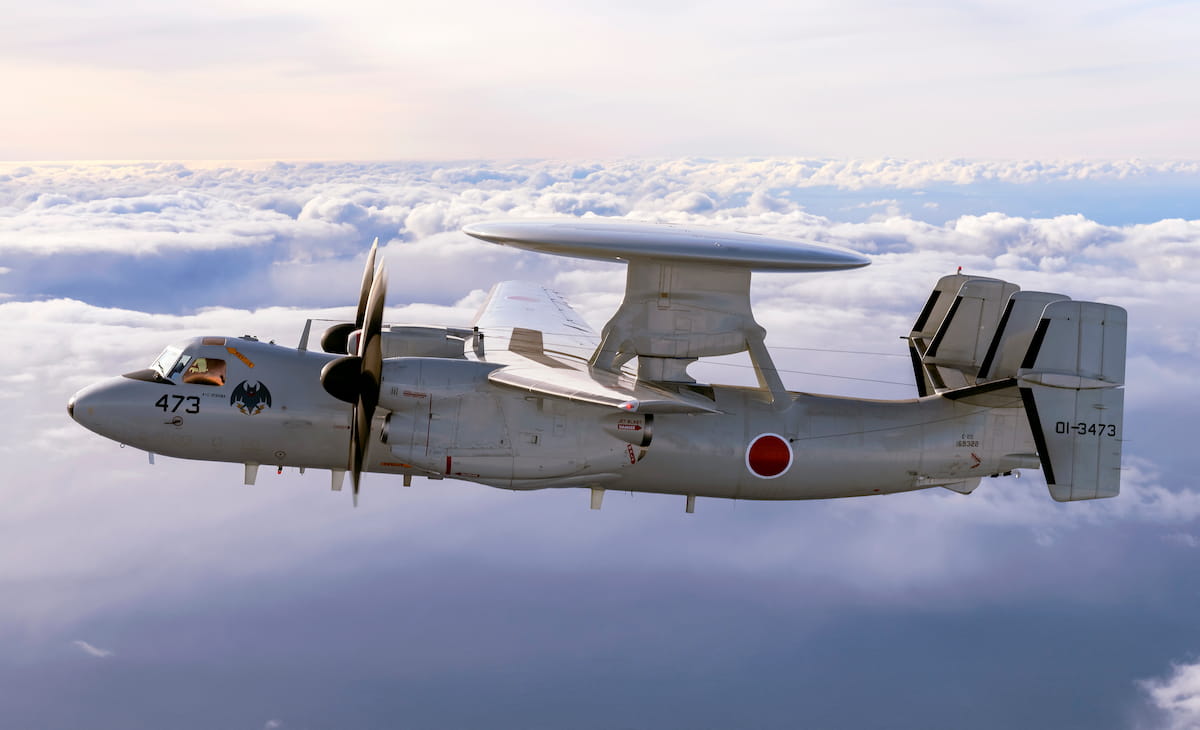
The Air Self-Defense Force's E-2D. Inside the disc-shaped rotodome is the AN/APY-9 radar, an AESA radar capable of simultaneous monitoring of the sea and the sky. Although it uses the relatively low frequency UHF band, excellent signal processing capability compensates for the loss of resolution. Photo: Satoshi AKATSUKA Decentralization of Control Capabilities and the “Airborne Command Center”
A new trend in recent years is “decentralization.” Preparing a small number of expensive, high-performance, high-value assets would be devastating if they were discovered and destroyed. Instead, dispersing forces into small groups and allowing them to move swiftly makes them harder to detect. At the same time, linking these assets and forces in a network allows for the cleverness of centralization in terms of operation, even though they are physically dispersed. This is the direction we are heading in military affairs. While there are precedents for decentralization and mobility alone dating back to World War II, the new difference is the addition of networking and powerful command and control capabilities.
From this perspective, ground-based radars, command posts, and control systems are highly vulnerable and prone to jamming and/or destruction, so one might argue that it would be better to fully utilize the value of the E-2D, which can airborne its radar and control functions and operate from relatively small airfields.
Only by pushing this idea that far will it become meaningful to say, “We will be able to mount the F-35B on the Maritime Self-Defense Force's STOVL carriers and operate them from the sea,” and “We will combine this with the E-2D, which takes off from land.”
Furthermore, if information could be shared not only with the E-2D and F-35B but also with ground-based air defense units and air defense ships at sea, a thicker layer of defense would be created. Aegis ships are equipped with Link 16 data links, and Patriot SAM units can also share information via the link. This calls for the creation of a system and structure that provides situational awareness and operational command across land, sea, and air domains.
Therefore, during air combat at sea, the E-2D acts as the “airborne command center,” coordinating defensive tactics.
A map showing the locations of Japan's air surveillance radars (28 radar sites), mobile aircraft control and warning squadron (4 sqs), Direction Centers (4 locations), and AEW and AWACS(E-2C/E-2D, E-767). Radar sites and Direction Centers are located in the Japanese archipelago and the southwestern islands, but the Pacific Ocean is empty.